A Photo A Day

A Photo A Day
Big Red

Total Pageviews

Wednesday, August 17, 2011

Day Trips Around The Riverland


Basing ourselves around Loxton, New Residence and Moorook allowed us to do so many wonderful day trips.

Nearly always, taking a picnic lunch with us or just simply ducking into one of the many wonderful local bakeries and trying their pies, or in particular their apricot slices, which are to die for, there are so many endless possibilities for those with a little sense of adventure.

Too many to list, but amongst them are Chowilla Conservation Park, Barmera, Berri, and Waikerie, which included a trip into the Maize Conservation Park, and the Broken Cliffs at Taylorville.

There is a certain ambience around this area, with the wonderful old stone built houses, some in ruins, others have been renovated and restored to their original style and are just quite simply awesome - makes you want to just go and buy one.

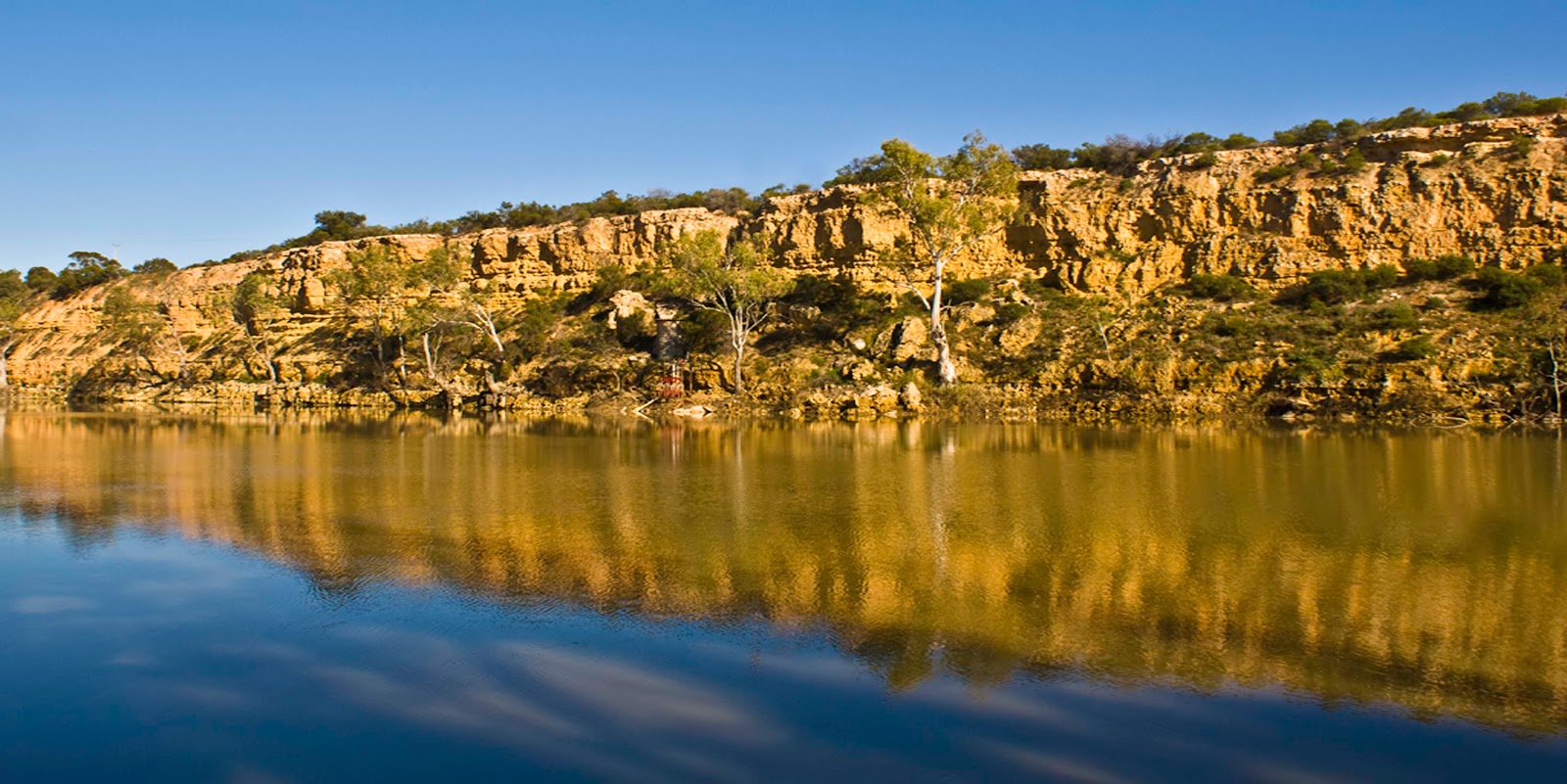
Just outside of Loxton is a place called Headings Landing - its purely a site to behold,  The sun shining off the limestone cliffs is something from a painters brush.

Headings Landing

Lookout Over The Murray

We really haven't left the Murray as it has always been within a whisker of us, almost every where we have been, and such a mighty river it is too and we really haven't got to the best yet.


 Day trips around the Riverland

ChowillaConservation Park

Located 50 kilometers from Renmark, Chowilla comprises 18,000 heactacres of flood plain and wetlands.  Campsites are available, but there seemed none suitable for our big rig

Chowilla Reserve is a short drive from Moorook and one that when we got the break in the weather, we took the opportunity to go and have a look.  A historical site and home of the Old Customs house.

To stop smuggling at the South Australian Border, a customs port entry and Boarding Station as gazetted in April 1884.

The first sub-collector of Customs was Robert Barker, who salary included the house and an allowance for a servant.  There was a large iron shed to store goods for the steamers and separate sheds for cargoes for sale in South Australia and New South Wales.

Very few actual taxes were collected at Port Murthoo:  it seems that the officers’ main role was to board the vessels at the border and to seal any dutiable goods, which would then be charged at Renmark or Morgan.

In 1904 the abandoned Customs House, became part of a station homestead and the area became known as “Borders Cliffs”.

Sand Dunes at Chowilla

Part Of Overland Station
Ochre Cliffs at Chowilla

Part Of The Old Customs House That Remains


Broken Cliffs – Taylorville via Waikerie

Broken Cliffs ~ Waikerie

The Beautiful Red Gums Against the Broken Cliffs

Struggling for Life

The contrast of Colors against The Cliffs
 Barmera and Lake Bonney

Lake Bonney is the major draw card to Barmera. When we visited there two years ago the lake was virtually dry, but now is alive and well and offers some wonderful photographic opportunities.  During our stay at New Residence we met with some other grey nomads, Phil and Sue, who were doing a house sit at Barmera and came over to meet us and we met a few times after that and have managed through this wonderful technicolgical world to keep in touch.


Barmera is a pretty little town nestled in the heart of the Riverland.  The Lake offers so many opportunities for any aquatic sport and a fisherman’s paradise.  It is a fresh water lake fed from the Chambers Creek wetland system.  The camps book offers free camping on the banks of the lake, but nothing really suitable for our big rig.

Barmera is steeped in history, being part of the Cobdogla Station which was established in 1846. The first European to discover Lake Bonney in 1838 was overlander Joseph Hawdon. The National Trust owned Overland Corner Hotel is a museum but is privately leased and operates as a licensed hotel, whilst the Cobdogla Irrigation & Steam Museum has approximately 12 open days a year when the train and traction engine steam up for rides.  Also home now, to our latest junior Wimbledon Champion.

Barmera has a country music festival as well each year, but unfortunately it clashed with the Hot Air Balloon Festival, and in retrospect we should have done that instead.

Many Murray river reserves to visit including Loch Luna which offers cruises around the back waters of the river at a very affordable price.  Many of the reserves were still closed and undergoing clean up work after the floods that hit the area earlier in the year.  This clean up programme could take a fair amount of time and therefore many of the free camps are closed until further notice.

My challenge as a photographer was to get a photograph of the jetty.  And Challenge it was, but here are a few attempts.


My Favourite Shot


Napier Hotel Ruins

Just a few minutes drive from Barmera is the ruins of the Old Napier Hotel, very interesting and well worth the drive out to see them and take in all the history.The free camp is not that far from here, but we didn't seem to think it very good and certainly wouldn't have fitted our rig in there.

Overland Corner Hotel - certainly well worth the visit, but be warned, don't go on a Sunday, unless you have booked. Service was very ordinary, and certainly over priced for what it was.

Lots of wonderful things to see around the Riverland, and I am sure that I have only just touched on them. As they say - "take time to smell the roses" and you will be surprised what you will find and discover.

Be aware of the fruit and vegetable restrictions of the Riverland before you go. If you purchase any fruit of veg you must at all times have a receipt to say that you have purchased them within the Riverland area - big penalties apply if you are caught.

Have had a great time here, and met some wonderful people, but it comes time when we have to move on, if we are ever to make it to the west, but the best of the Mighty Murray is yet to come.  We move onto Mannum next and heading towards the mouth of the Murray.  At Moorook we met a couple, Shelley and Gary, who are still travelling with us now, and we have had such a great time with them and we hope you will enjoy the next couple of blogs as we travel along together.


Gary and Shelley


BigRedBusTouringCo.com: Moorook to Perry Sand Dunes

BigRedBusTouringCo.com: Moorook to Perry Sand Dunes: "The Perfect Rippled Dune - 2009
This - our second visit to Perry Sand Dunes, was just about as good as they last, but a few things got..."

Moorook to Perry Sand Dunes

The Perfect Rippled Dune - 2009
This - our second visit to Perry Sand Dunes, was just about as good as they last, but a few things got in the way of really being able to enjoy it.

As it was school holidays, many tourists around and this wonderful area, had just been decimated by people who have no respect for this wonderful environment.

How The Dune Had Changed Since the Last Time We Were Here

The Ruination as a Result of People Sliding Down The Dunes on Anything From Cardboard Boxes to Car Bonnets - just the Rubbish left Behind!!
It is sad to see, what is usually such a pristine and unique area left in such a state, and maybe it has come time to have the area closed off to the public and access via tour operators only - much like the Anna Bay Dunes, near Nelsons Bay in NSW.  Sand Dunes such as this are a slowly dying across Australia and we need to preserve what there is left of them.  My little soap box bit!!!
For a little history of the area  :-  According to geologists, the Perry Sandhills originated after an ice age (40,000 years ago) and are formed by wind erosion over thousands of years. The dunes are located just outside of Wentworth (6km from PO), and are a unique land formation of 400 acres of continuously shifting sand dunes.

Skeleton remains of giant mega-fauna (kangaroos, lions, emus and wombats) have been found there. Replicas of these animals are now on show at the Pioneer Museum in Wentworth. Aboriginal tribes used this area to camp and hunt. Evidence of this is still being uncovered as the sands drift.

Once in the carpark walk behind the shelter and locate a single Murray River Gum tree in the middle of the sand. Climb the dunes and walk in under the canopy of the Murray River Red Gum -possibly more than 500 years old. The sand over time has completely covered the trunk (perhaps 15 to 20 feet) and youll find yourself in the bower of this age old tree - a magnificent sight!!

Barry Atop One of The Many Dunes Trying Out His New Camera

Look Hard Enough and There Will Be Those Lovely Ripples

Overlooking One Of The Dunes

The Struggle Of Life
The sandhills were used as a bombing range during WWII. Now, the area is utilised as backdrop for many films, T.V. shows and ads, theatre/music presentations.

If ever in the area, Perry Dunes is certainly worth the visit.
Came home via the township of Wentworth and the highway back to Moorook.  Just wonderful travelling through the Mallee Country and with the country looking so good after all the rain, the wild flowers are out and make a wonderful sight.

Claypan Grasses

Claypan
Flowering Carpet Of Yellow
Old Mallee Fence
Ruins Of Times Past
Aftermath of the Rains
Murray River Cliffs at Paringa

Emus on The Dunes

There is a free camp at Perry Dunes, but fairly basic, but good enough to be able to spend a couple of enjoyable days wandering the dunes....

Stay tuned for our next journey as we move on further down the Murray.


Moorook - Wentworth ~ Annabranch Shearing Shed


Annabranch Shearing Shed ~ circ 1860

 Just a slight deviation from the Murray River, but still  a wonderful drive and one well worth spending the time on doing,

We did this trip a couple of years ago, when we were here, and took the road down past Lake Victoria and Rufus River, but decided to take a bit of a different route this time, when we heard of an old Shearing Shed along the track. (Oh no!!! not another shearing shed???)

There’s a back road from Renmark to Wentworth, which actually bypasses the Fruit Fly block at Yamba, but take one through some wonderful ‘outback country’ and continues on via Perry Sand Dunes, a place we have been before, but is just almost irresistible to any photographer.


Following the GPS, which has thus far proved to be fairly reliable, took us down a side road, which proved to be almost a dead end and onto private property.  We had heard, from friends Phil and Sue, that somewhere in the area, towards the Dunes was another old Shearing Shed.

Suggesting that we pull into a house and ask directions, we spoke to this lovely lady, who just happened to be the wife of the owner of the shed.  After finding out that her husband and son where down at the shed, she kindly gave us permission to go in and see the shed.


Getting back in the car, we travelled down the road a few kilometres, we came across some sheep being mustered and there off to the right was this wonderful old shed.

Mustering the Sheep
Sheep In The Yards

Lambs Feeding

The Stands

The Clip

The Count - The Board with the Shearers Numbers For the Day On The Board

The Stands
The Anabranch Shearing shed dates back to the 1860’s and is in it’s original state.  Had a great chat, with the owner Greg and his son Craig, who kindly gave us a wonderful history lesson and a guided tour of the station.  The old Shearers quarters are now hired out to fishermen and groups on the odd occasion, offering the absolute basics, but certainly enough for that week or so of fishing.  These sheds are so full of character and history, they are wonderful to visit. The smells of the lanolin are still distinct and all just add to the atmosphere of the environment.  Each is different in its own right and Annabranch was originally a 24 machine stand shed and now operates on 12 electric stands.  Lots of work needs to be done to the shed to help it last another 100 years.  lets hope they get the money to do it.

Shearer's Quarters

Fishing Hut


Old Quarters Door
A Place To Sit

Old Red Gum On The Banks Of The Murray Outside The Door of the Shearers Quarters

Annabranch Creek Old Bridge
After enjoying another picnic lunch by the banks of Annabranch Creek, which is tributary of the Murray River, we headed off towards Perry Sand Dunes..........


Just follow us as we head on down the road to Perry Sand Dunes


The Might Murray - From Moorook To Mannum


 The Mighty Murray - Part 2

Moorook to Blanchetown


We have now left the Murray River and will now have to back track and finish off our journey along the Murray River.

Last you heard, we were at New Residence and our little trip down memory lane.

After a wonderful few weeks camped along side the Murray at New Residence, we finally got enough clear weather to move the bus off the river flats.  During the dry these flats are dusty and sandy, but when wet, they make life difficult in maneuvering a vehicle such as the bus out off the flats.  After a few dry days we opportunity presented itself to get the bus out off the flats and so off we went.  Barry with a fair bit of trepidation steered the bus out up through the property and he managed to get it out without any drama.

We travelled a whole 13kms down the road towards Moorook and camped ourselves at the Moorook Reserve, where we stayed another couple of weeks.  ($12 pn with power and toilets) so reasonably cheap.  Quite a few others camped there as well.

Our Camp at Moorook - the little van to the left of us had a family of 4 living in it and where just starting their trip around Australia - wonder how long they lasted with the 4 of them in that little van


From Moorook the weather changed remarkably and we had some great weather, in contrast to what had been at New Residence, which gave us the opportunity to do some day tripping.

So many little towns and settlements to go and investigate, and towards the middle of July we took ourselves off towards Blanchetown, about 40 kms from the township of Waikerie.

Just before entering the township of Waikerie, a small locality called Lowbank, off to the side of the road was one of the oldest shearing sheds we have seen, and off course things got the better of me and I had to investigate.  What an amazing sight with the walls built out of what is seemingly a South Australian tradition of walls built of stone. Inside, the timer work was of good old mallee timber, the pens and frames still in their rough cut form.   The stonework is just amazing, and a real sign of the skill of the tradesmen that built them, and to see so many of them still standing today is testament to their skill.  The tradition lives on in this wonderfully historic state and even today, the trade is well and truly alive, with many buildings still being built in the same tradition.

Lowbank Shearing Shed

The Mallee Timber Pens of Lowbank Shed

The Stone work at the Back of the Shed

The Mallee Timber work of the Pens

Back on the road and off to Blanchetown, a small and fairly insignificant little town, with not much left of it these days, but still with the Might Murray to hold it up and home to many a houseboat.

Old Ruins at Blanchetown

Old Cottage at Blanchetown

Lutheran Church At Blanchetown

Blanchetown is the first of seven locks along the Murray River and is very unique in it's innovation. 

Blanchetown's cliffs line the river on both sides and are most famous for the beauty of their changing colours. Studded with fossils, they are also of considerable geological interest. This is classic river country, with lagoons, wetlands and a backdrop of vineyards and grazing land. The Blanchetown lock and weir – the first on the Murray – was completed in 1922. (The last one completed at Euston, near Robinvale, in 1937). It was named the William Randell Lock, after Captain William Richard Randell, the first river boat captain to navigate the River Murray in 1853.

Water is pumped for both irrigation and for diversion to major urban and industrial centres including Adelaide, and the 'Iron Triangle'.

Barry Admiring What is Left Of The Old Pump House

View From Inside The Pumphouse

The Murray Through The Window Of The Old Pumphouse

Design and operation of Locks and Weirs

A lock is a simple design; a rectangular chamber of concrete with gates at each end. The locks permit boats to move from one level to another. Locks similar to those of today were first used on the Grand Canal in China during the eighth century. In the fifteenth century, Leonardo da Vinci is reputed to have designed the first lock with the familiar pair of mitred swing gates at each end. This is the type of lock which is used on the Murray. The gates close to form a 'V' against the current and upstream water pressure helps to keep them closed and make a watertight seal. The pressure of water within the lock chamber keeps the downstream gates closed.


Lock 1 - At Blanchetown

Looking Down Toward The Lock

Picnic Spot At Blanchetown
Blanchetown  Bridge

After our usual picnic lunch we headed off towards Morgan, where we had been a couple of years ago, and continued on following the wonderful limestone cliffs of the Murray River.  Taking a different road this time we headed off through the town of Caddell, a small but quaint little town, and a place but we must re-visit, but time was getting on, and as usual our day was coming to a close and it was time to head back to camp.

A feature of any of these trips around the river land is the magnificence of the sandstone cliff faces, which on closer inspection contain thousands of fossillised shells.
The Cliffs  ~ on The Road To Morgan

Headings Landing Near Loxton

Maize Conservation Park - Waikerie ~ South Australia

Broken Cliffs ~ Waikerie ~ South Australia

What a perfect day it had been and the weather had been so good to us today, and our reputation as ‘The Rainmakers’ had,at least, for the time being, been put on hold. 

We can only hope for many more days like this and hope to share them with you soon.